Have you ever noticed how the deep thump of bass from a passing car carries far down the street, while a child's high-pitched scream seems to cut right through a crowd? That contrast is frequency at work. How frequency affect sound is one of the most fundamental questions in acoustics — and understanding the answer is essential for anyone involved in noise control, occupational health, or environmental compliance.
This guide breaks down the science clearly and shows you exactly what measures sound frequency is measured in professional settings.
What Is Sound Frequency and How Is It Measured in Hz?
Sound frequency is the number of complete vibration cycles a sound wave makes per second. It is measured in Hertz (Hz) — so a sound at 1,000 Hz completes 1,000 wave cycles every second. The higher the number, the faster the vibration.
Frequency vs. Amplitude — What's the Difference?
These two properties describe entirely different aspects of a sound wave. Frequency determines pitch — whether a sound is high or low. Amplitude determines loudness, reported in decibels (dB). A police siren and a whisper can share a similar frequency (pitch) but differ enormously in amplitude (volume). For professional sound measurement, you need equipment that captures both dimensions accurately.
How Does Frequency Affect Sound? 5 Key Ways Explained
Understanding how frequency affects sound goes well beyond music theory. For engineers, safety officers, and environmental professionals, these relationships have direct practical consequences.
High Frequency = High Pitch: Why Your Ears Hear a Difference
Frequency is the primary driver of perceived pitch. A piccolo playing at ~4,000 Hz sounds shrill and piercing; a tuba rumbling at ~80 Hz sounds deep and resonant. In industrial and environmental contexts, high-frequency machinery noise (fans, compressors, grinders) is often more fatiguing and potentially more damaging to hearing than low-frequency rumble at the same decibel level.
Frequency and Wavelength: The Inverse Relationship You Need to Know
Frequency and wavelength are mathematically linked by the formula vw = f × λ, where vw is the speed of sound (~343 m/s in air), f is frequency in Hz, and λ is the wavelength. The key takeaway: as frequency increases, wavelength decreases. High-frequency sounds have short, tightly packed waves; low-frequency sounds have long, widely spaced waves. This directly affects how sound behaves in the real world.
How Frequency Affects Sound Travel and Diffraction Around Obstacles
Low-frequency sounds (long wavelengths) bend easily around obstacles like walls and buildings, which is why you hear the bass from a neighbor's stereo through a closed door but not the vocals. High-frequency sounds (short wavelengths) are more directional and get blocked or absorbed more readily. This is critical knowledge for construction site monitoring, where low-frequency equipment noise spreads far beyond the perimeter.
Does Frequency Affect Sound Speed? What the Science Says
A common misconception: many assume higher frequency means faster sound. In open air across the audible range of 20 Hz to 20,000 Hz, sound speed is essentially independent of frequency. If this were not true, music from a live band would reach your ears in scrambled order — low notes arriving later than high ones. The physics confirms that they travel together, which is why the frequency range of your measurement equipment matters more than its response time.
How Frequency Affects Human Hearing and Workplace Safety
The healthy human ear detects sounds between 20 Hz and 20,000 Hz. However, sensitivity is not equal across that range — human hearing is most acute between 2,000 and 5,000 Hz and less sensitive at the extremes. This is precisely why frequency weighting filters exist in professional sound measurement. Prolonged exposure to noise above 70 dB — especially in mid-to-high frequency bands — can begin to damage hearing. In occupational settings, this makes frequency-accurate measurement not just best practice, but a legal compliance requirement.
What Measures Sound Frequency? Understanding Frequency Weighting (A, C, Z)
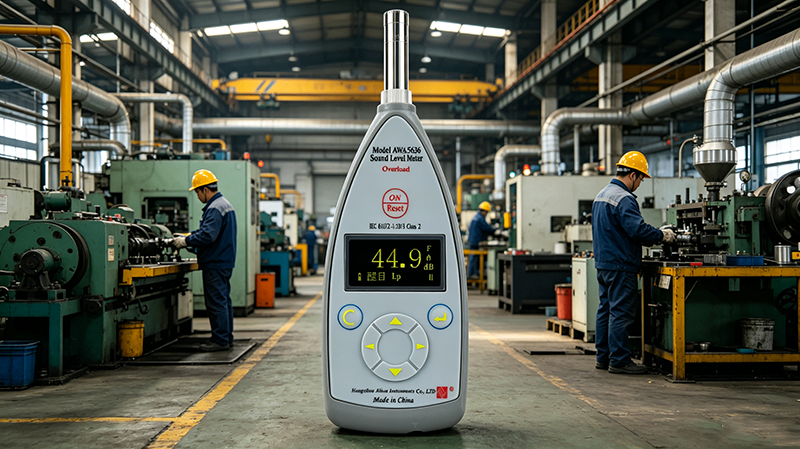
A standard decibel reading tells you how loud a sound is, but not how damaging or disruptive it is across different frequency bands. That is where frequency weighting comes in — filters built into professional sound level meters that adjust measurements to reflect real-world human experience and regulatory standards.
A-Weighting vs. C-Weighting — Which Frequency Range Should You Measure?
A-weighting (dBA) mimics the sensitivity of the human ear, reducing the influence of very low and very high frequencies. It is the standard for occupational health assessments, community noise ordinances, and most environmental regulations. C-weighting (dBC) gives more weight to low-frequency content and is used for assessing peak and impulse noise — such as impacts, explosions, or heavy machinery. Z-weighting applies no filter at all, giving a flat response across the entire frequency range, ideal for pure acoustic research or baseline comparisons.
Choosing the wrong weighting can misrepresent the actual risk or regulatory compliance status of a site.
Recommended Acoustic Testing Equipment for Frequency-Based Sound Measurement
Knowing the physics is only half the challenge. The other half is having the right instrument in your hands when you step onto a construction site, factory floor, or community complaint location.
Why the AWA5636 Kit Is the Go-To Choice for On-Site Sound Measurement
The AWA5636 Portable Sound Level Meter Kit from Aihua Instruments is purpose-built for professionals who cannot afford gaps in their frequency data. Rather than carrying multiple devices, calibrating separately, or hunting for a printer after the fact, the AWA5636 kit gives field teams everything they need in a single, ready-to-deploy package.
Here is what makes it stand out for frequency-based sound measurement:
· Frequency range: 20 Hz–12.5 kHz — covers the full human audible spectrum so no critical band is missed
· A, C, and Z frequency weightings — switch between regulatory, peak, and unfiltered modes to suit any measurement standard
· IEC 61672-1:2002 Class 2 accuracy — meets international compliance requirements for environmental and occupational reporting
· Measurement range: 30–140 dB — from near-silent ambient environments to extreme industrial sources
· 2 GB onboard memory — stores 8,000 measurement groups or over 500 hours of continuous data, eliminating the risk of data loss mid-survey
Acoustic instruments
AWA5636 Portable Sound Level Meter Kit
Ideal for industrial noise surveys, community noise ordinance measurements, and environmental noise monitoring applications.
📊 Sound level meter (SLM)
🎚️ A, C and Z weightings
📈 30 to 140 dB
🔬 0 Hz ~ 12.5 kHz
What's Inside the AWA5636 Kit? A Complete Sound Measurement Solution
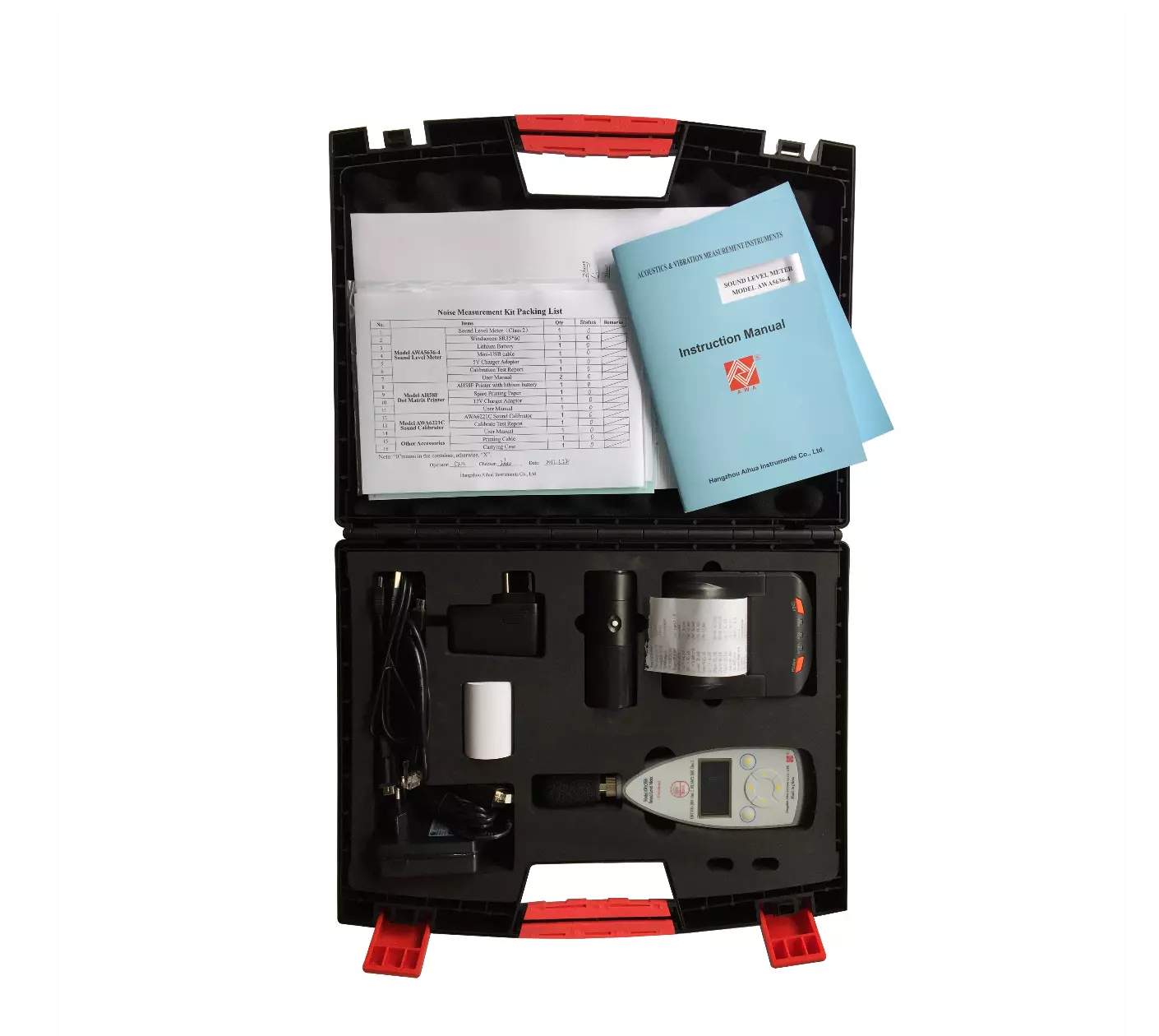
The kit ships with three instruments that solve the three most common field frustrations:
1. AWA5636-4 Sound Level Meter — the core measurement device, weighing just 240g with a 30-hour battery life, OLED display, and USB data export
2. AWA6022A Sound Calibrator — ensures your readings are traceable and accurate before every measurement session, critical for compliance documentation
3. AH58F High-Speed Dot Matrix Printer — prints SPL Min, SPL Max, and Leq results on-site with date and time stamps, giving you instant documentation for complaint response or regulatory submission without returning to the office
For teams responding to noise complaints, conducting workplace noise assessments, or submitting environmental reports, this all-in-one kit eliminates the logistical delays that cost time and credibility.
Applications — Where Does Frequency Measurement Matter Most?
The AWA5636 kit directly addresses the frequency-related challenges that come up repeatedly in these professional scenarios:
· Industrial noise surveys — identifying which frequency bands from machinery exceed safe exposure thresholds
· Environmental noise monitoring — measuring community-impact noise with A-weighted sound measurement for regulatory submissions
· Construction site noise monitoring — capturing low-frequency equipment noise that travels well beyond site boundaries
· Workplace noise assessment — generating Leq, TWA, and DOSE data required for occupational health compliance
· Traffic noise measurement — analyzing broadband frequency profiles from road and transit sources
Conclusion — Master Sound Frequency Measurement with the Right Equipment
How frequency affects sound shapes everything from the pitch we perceive to the health risks workers face, and the compliance obligations businesses must meet. High frequency means short wavelength, higher pitch, and more directional propagation. Low frequency means long wavelength, deeper tone, and greater ability to travel around obstacles and into communities. Getting those measurements right — across the full 20 Hz to 20,000 Hz spectrum, with the correct frequency weighting — is non-negotiable for any professional noise assessment.
The AWA5636 Portable Sound Level Meter Kit from Aihua Instruments delivers exactly that capability: A, C, and Z frequency weightings, IEC Class 2 accuracy, on-site printing, and a full kit that is ready to deploy the moment you arrive on-site.
Ready to measure every frequency with confidence?
Get a quote today at hzaihua.com.




 No.37 Xianxing Rd Xianlin Town Yuhang District Hangzhou Zhejiang China
 Phone/ Whatsapp: +86 19012832378
 marketing@hzaihua.com