Noise pollution is one of the most underestimated environmental hazards of our time. Prolonged exposure to excessive noise can lead to hearing loss, sleep disruption, cardiovascular stress, and reduced productivity — yet unlike air or water pollution, it leaves no visible trace. The first and most critical step to controlling noise is knowing exactly how loud your environment is.
So how do you measure noise pollution? Whether you're an industrial safety officer, an environmental engineer, or a contractor managing vehicle noise compliance, this guide walks you through the units, methods, and recommended acoustic testing equipment you need to get accurate, actionable results.
What Measures Sound? Understanding Decibels (dB) and dBA
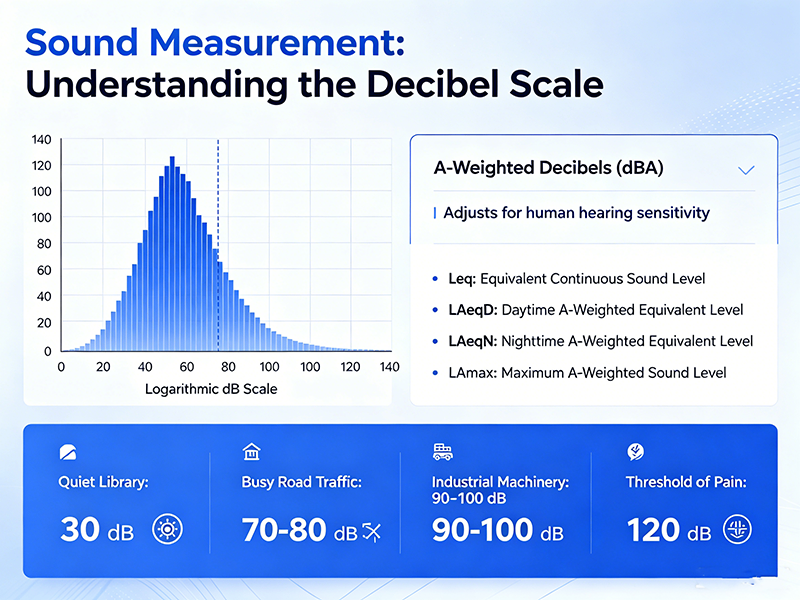
Sound measurement is based on the decibel (dB) — a logarithmic unit that expresses the intensity of a sound wave relative to the threshold of human hearing. Because the decibel scale is logarithmic, a 10 dB increase represents a tenfold increase in sound energy, not just a slight bump.
In practice, noise measurement for environmental and occupational purposes uses A-weighted decibels (dBA) — a frequency-adjusted scale that mirrors how the human ear perceives sound. Key metrics you'll encounter include:
· Leq (Equivalent Continuous Level): The time-averaged noise level over a defined period — the most common metric in environmental assessments.
· LAeqD / LAeqN: Daytime and nighttime equivalent levels, typically split at 7:00 a.m. and 10:00 p.m.
· LAmax: The peak noise level recorded during a measurement period.
For quick reference: a quiet library is around 30 dB, busy road traffic is around 70–80 dB, industrial machinery is around 90–100 dB, and the threshold of pain is approximately 120 dB.
How Do You Measure Noise Pollution? 3 Proven Methods Explained
This is the heart of any noise management program. The right method depends on your environment, timeline, and compliance requirements.
Method 1 — Spot Reading: Quick Single-Point Sound Measurement
The simplest approach to measuring noise pollution in the field is a spot reading using a handheld sound level meter. The instrument is placed at the point of concern — near a machine, at a property boundary, or beside a road — and a single instantaneous or short-duration reading is recorded.
Best for: factory floor checks, vehicle exhaust noise compliance, and on-site machinery assessments. Per ISO 9612, the microphone should be positioned at ear height (approximately 1.5 m on a tripod), away from walls and other obstructions, to avoid reflected sound skewing the results.
Method 2 — Continuous Noise Level Measurement for Trend Analysis
When a single reading isn't enough to capture the full picture, continuous measurement over a set time window provides richer data. The sound level meter is mounted on a tripod and records noise at defined intervals — typically every few seconds or minutes — producing Leq averages and LAmax peaks across the monitoring period.
This method is ideal for road traffic surveys, construction site monitoring, and occupational noise assessments where noise fluctuates significantly throughout the workday.
Method 3 — Long-Term Noise Monitoring for Environmental Compliance
For regulatory compliance, urban planning, or industrial permitting, long-term monitoring captures noise measurement data over weeks, months, or even years at intervals as short as 5 minutes. This data reveals noise pollution patterns, identifies persistent sources, and supports decisions on noise barriers, zoning restrictions, or operational changes.
Per ISO/IEC 17025 guidelines, monitoring stations used for regulatory-grade assessments should be calibrated annually by an accredited laboratory to ensure ongoing accuracy.
Recommended Acoustic Testing Equipment: What Tools Do You Actually Need?
Choosing the right instrument is where noise management becomes practical. Here's what the recommended acoustic testing equipment looks like for different real-world scenarios — all available at hzaihua.com.
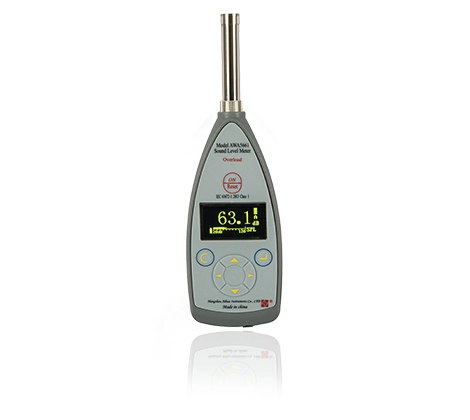
AWA5661 Digital Sound Level Meter — Pocket-Sized Precision for Teams on the Move
If your team needs to conduct rapid sound measurement across multiple locations without carrying bulky equipment, the AWA5661 is built for you. Small enough to fit in a pocket, it eliminates the hassle of transporting large instruments to factory floors, vehicle testing sites, or ship machinery rooms.
Complying with IEC 61672 Class 1 — the highest accuracy tier for sound level meters — the AWA5661 delivers trustworthy data whether you're surveying industrial noise, assessing machinery output, or monitoring vehicle pass-by noise. Its wide dynamic range means you won't need multiple devices to cover different noise environments, and its RS232 output allows seamless data transfer to your reporting system. With an operating temperature range of -15°C to 50°C, it performs reliably in both cold storage facilities and hot industrial environments.
For field teams that need precision without compromise, the AWA5661 turns what used to be a cumbersome process into a fast, accurate, and portable workflow.
Acoustic instruments
AWA5661 Digital Sound Level Meter
The model AWA5661 sound level meter has adopted advanced digital detection technology and has reliable and steady performance, a wide linear operating range, etc.
Widely used in Industrial Noise Surveys; machinery, vehicles, ships, etc. Complies with IEC 61672 Class 1
📊 Sound level meter (SLM)
🎚️ Small and lightweight
📈 Wide Dynamic Range
🔬 Digital signal processing
AWA5662 Sound Level Meter — Purpose-Built for Vehicle and Industrial Noise Compliance
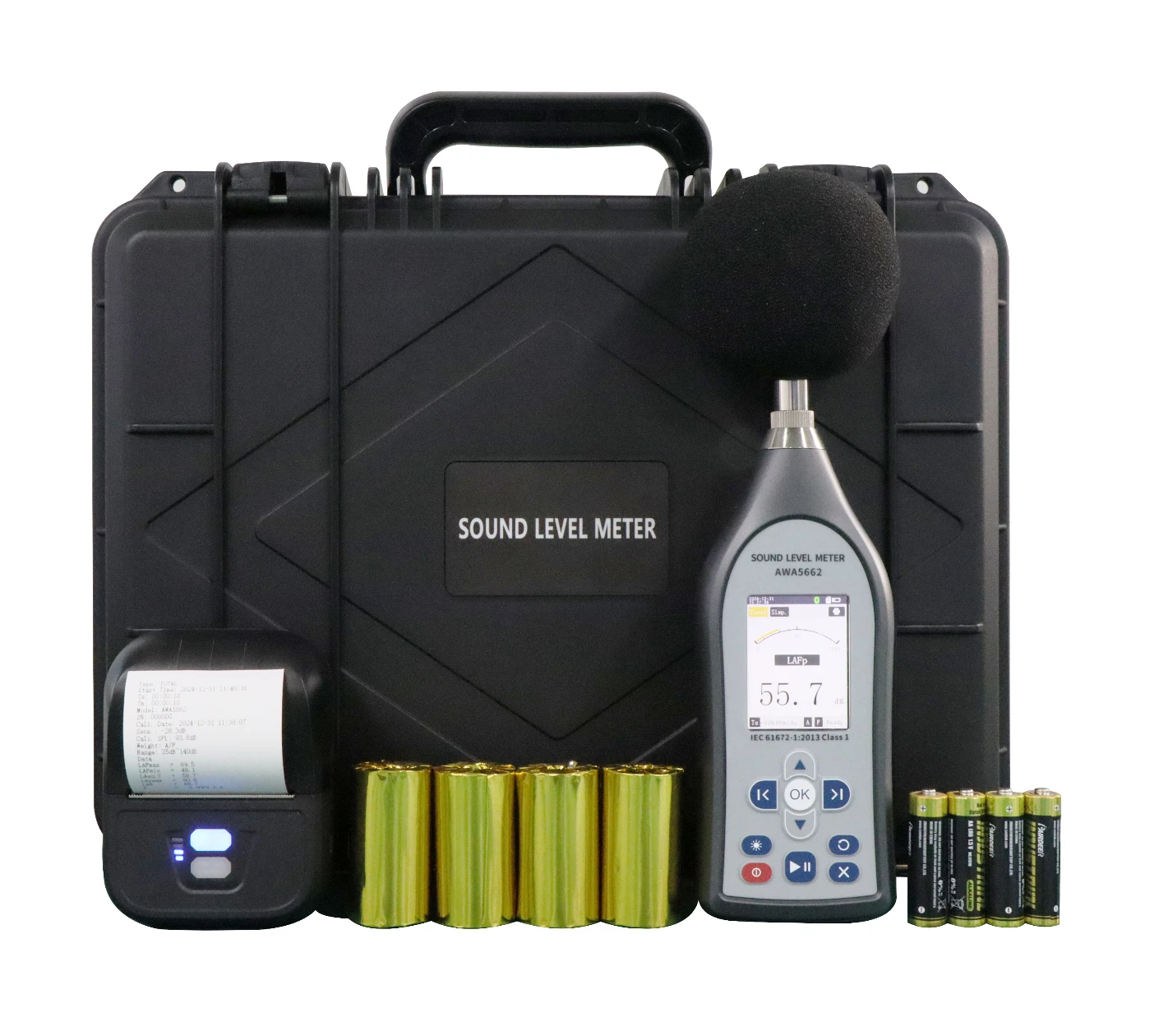
When your work centers on vehicle noise measurement, motorcycle exhaust testing, or industrial noise surveys that demand on-the-spot documentation, the AWA5662 addresses a pain point most standard meters ignore: the need to produce printed results at the measurement site.
With its optional integrated thermal printer, inspectors and compliance officers can hand a printed noise measurement report to a client, operator, or regulator immediately — no waiting to return to the office, no risk of data being lost or misrecorded in transit. This single feature dramatically reduces administrative overhead for organizations running high-volume noise compliance programs.
Acoustic instruments
AWA5662 Class 1 Sound Level Meter
AWA5662 sound level meter meets the IEC 61672 Class 1. It is designed for industrial noise, vehicle noise, or motorcycle exhaust noise measurement.
The thermal printer is optional, which allows the user to print out noise measurement results on the site.
📊 Sound level meter (SLM)
🎚️ 1/1 & 1/3 octave analyzer
📈 25 dBA to 140 dBA
Meeting IEC 61672 Class 1 standards, the AWA5662 provides the certified accuracy required for regulatory submissions. An optional Class 1 sound calibrator ensures the meter stays within specification across every session, giving you defensible, audit-ready data every time.
What Do Your Noise Readings Mean? Safe Levels vs. Hazardous Zones
Once you have your sound measurement data, interpretation is straightforward with the right benchmarks:
· Below 70 dBA: Generally safe for prolonged exposure in most environments.
· 85 dBA: The OSHA action level — above this, hearing protection programs become mandatory in most jurisdictions.
· 85–100 dBA: Hearing damage risk grows rapidly with duration of exposure.
· Above 120 dBA: Immediate risk of injury; the threshold of physical pain.
This is precisely why IEC 61672 Class 1 instruments matter. A Class 1 meter has tighter tolerances (±1 dB) than Class 2 (±1.5 dB) — a seemingly small difference that becomes critical when a noise reading determines whether a facility passes or fails a regulatory inspection.
Start Measuring Noise Pollution Accurately — Your Equipment Choice Matters
Understanding how to measure noise pollution is the foundation, but the quality of your data depends entirely on the instrument in your hands. The right recommended acoustic testing equipment means readings you can act on, reports you can defend, and compliance you can demonstrate.
Contact Our Team →
Whether you need the portable precision of the AWA5661 for rapid field surveys, the on-site printing capability of the AWA5662 for vehicle and industrial compliance, or the all-in-one power of the AWA6228+ for comprehensive acoustic analysis, hzaihua.com provides IEC-certified sound level meters engineered for real-world demands.




 No.37 Xianxing Rd Xianlin Town Yuhang District Hangzhou Zhejiang China
 Phone/ Whatsapp: +86 19012832378
 marketing@hzaihua.com