CN
Aihua Instruments
Aihua Instruments
CN
How Do We Measure Loudness and Why Does It Matter?
Release time:2026.05.29 Views:31

Loudness surrounds us constantly — the hum of an air conditioning unit, the roar of traffic, the background noise of a factory floor. We experience it instinctively, but measuring it accurately is a different matter. Whether you're a safety professional documenting workplace noise exposure, an environmental consultant assessing community noise, or a sound engineer managing live event levels, understanding how loudness measurement works is the foundation of doing the job properly.

What Is Loudness and How Is It Different from Sound Level?

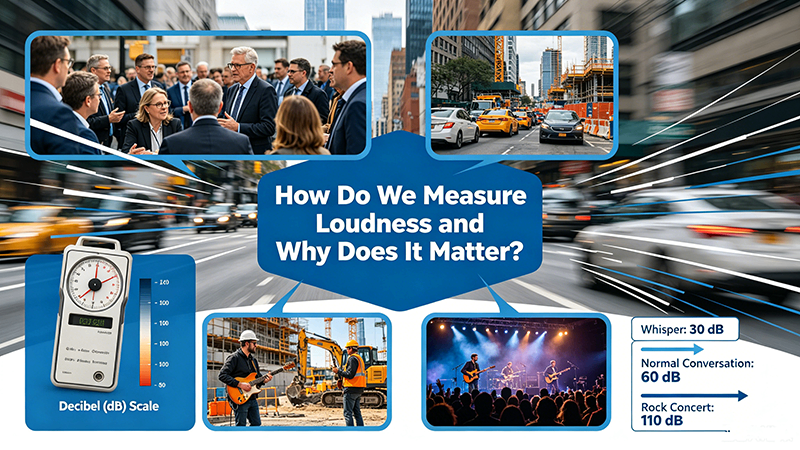
Sound level and loudness are related but not identical. Sound pressure level (SPL) is a physical measurement — it quantifies pressure variation caused by sound waves, expressed in decibels. Loudness is perceptual — it describes how loud a sound seems to a human listener.

Human hearing doesn't respond equally to all frequencies. A 60 dB tone at 1000 Hz sounds considerably louder than a 60 dB tone at 100 Hz, even though the physical sound level is identical. This is why frequency weighting is applied during professional loudness measurement.

The decibel scale is logarithmic, which suits sound level measurement well — human hearing spans an enormous dynamic range that would be impractical to express linearly. A useful rule of thumb: a 10 dB increase sounds roughly twice as loud to the human ear.

What Is Loudness.png

How Do We Measure Loudness? Methods and Tools Explained

The Sound Level Meter

The sound level meter is the primary instrument for professional loudness measurement. It captures sound through a precision microphone, processes the signal electronically, and displays a calibrated decibel reading.

For regulatory compliance or occupational health purposes, the instrument must be certified to IEC 61672 — the international standard defining performance requirements for sound level meters. Class 1 offers the highest precision; Class 2 is suitable for general surveys and environmental monitoring.

Frequency Weighting

· A-weighting (dB(A)) — mimics human hearing, standard for occupational and environmental noise measurement

· C-weighting (dB(C)) — used for peak measurements and low-frequency assessment

· Z-weighting (dB(Z)) — flat response, used in acoustic research

Key Loudness Measurement Parameters

· Leq — equivalent continuous sound level, averaging noise energy over time

· Lmax / Lmin — maximum and minimum levels during the measurement period

· Lpeak — instantaneous peak sound pressure level

· L10, L50, L90 — statistical percentiles describing noise distribution over time

How Is Loudness Measured Across Different Industries?

Occupational noise focuses on LEX,8h — daily noise exposure normalized to 8 hours. OSHA sets an action level of 85 dB(A); the EU Noise at Work Directive sets a lower action value of 80 dB(A). Compliance requires certified noise measurement with documented calibration records.

Environmental noise uses Ld, Ln, and Ldn — day, night, and day-night average sound levels — as the basis for noise mapping under ISO 1996 and the EU Environmental Noise Directive.

Live sound and venues increasingly require continuous data logging with time-history records, rather than single spot readings, to demonstrate responsible level management.

The Right Tools for Accurate Loudness Measurement

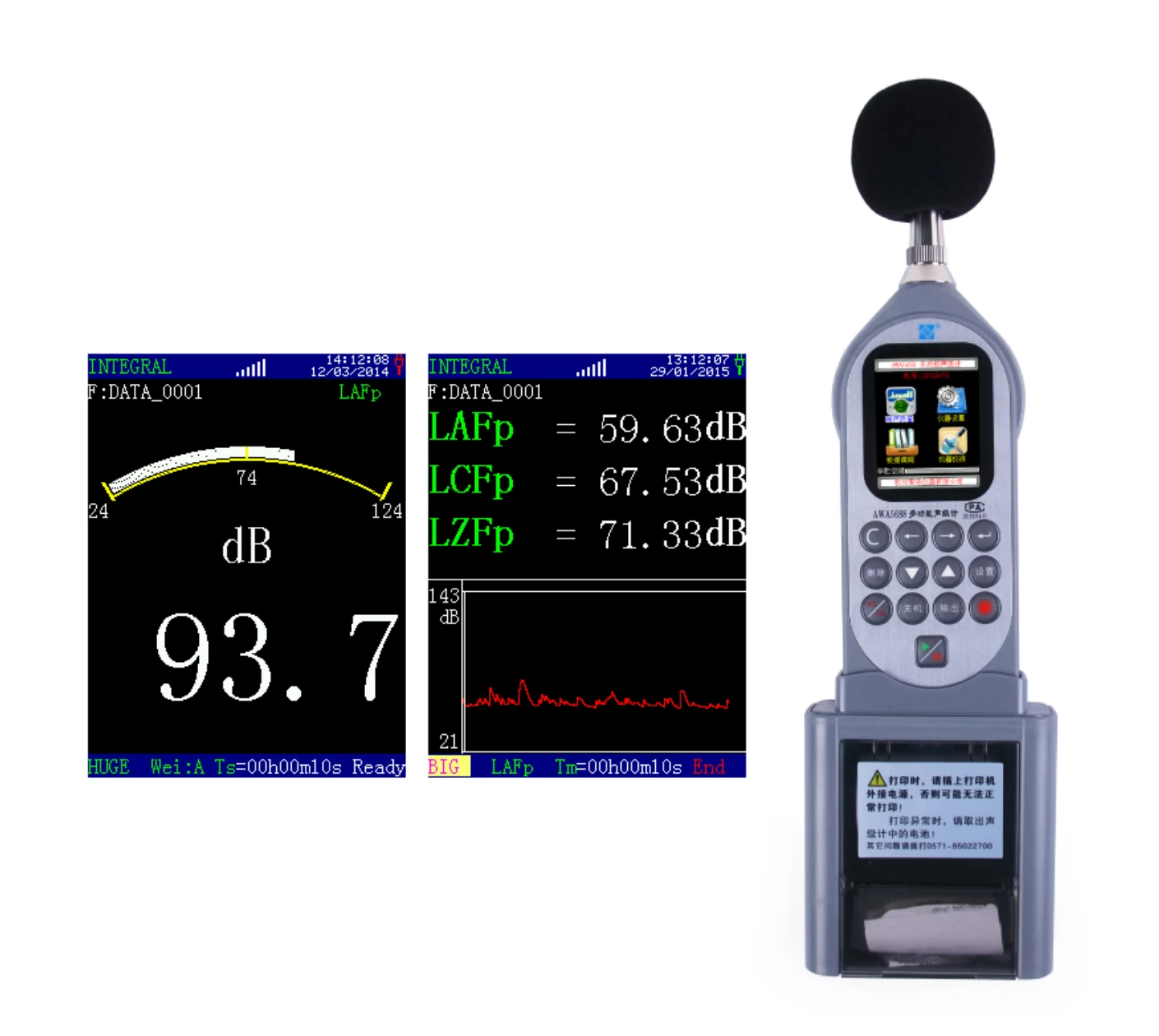
AWA5688 Handheld Multifunction Sound Level Meter

For professionals who need comprehensive loudness measurement without carrying multiple instruments, the AWA5688 integrates a sound level meter, 1/1 and 1/3 octave analyzers, and a noise dosimeter in one compact device. The 240×320 color display shows multiple parameters simultaneously, the measurement range extends to 133 dB, and 32G SD card storage supports continuous data logging with GPS location tagging. Compliant with IEC 61672 Class 2, IEC 61260 Class 2, and IEC 61252.

AWA6228+ Digital Multifunction Sound Level Meter

AWA5688 Handheld Multifunction Sound Level Meter

Model AWA5688 Handheld Multifunction Sound Level Meter has advantages of low power dissipation, powerful function, friendly and colorful display screen, and abundant content.

Multifunction and user- friendly sound level meter(integrating SLM, 1/1 OCT, 1/3 OCT analyzer, Noise dosimeter)

     View Details →    
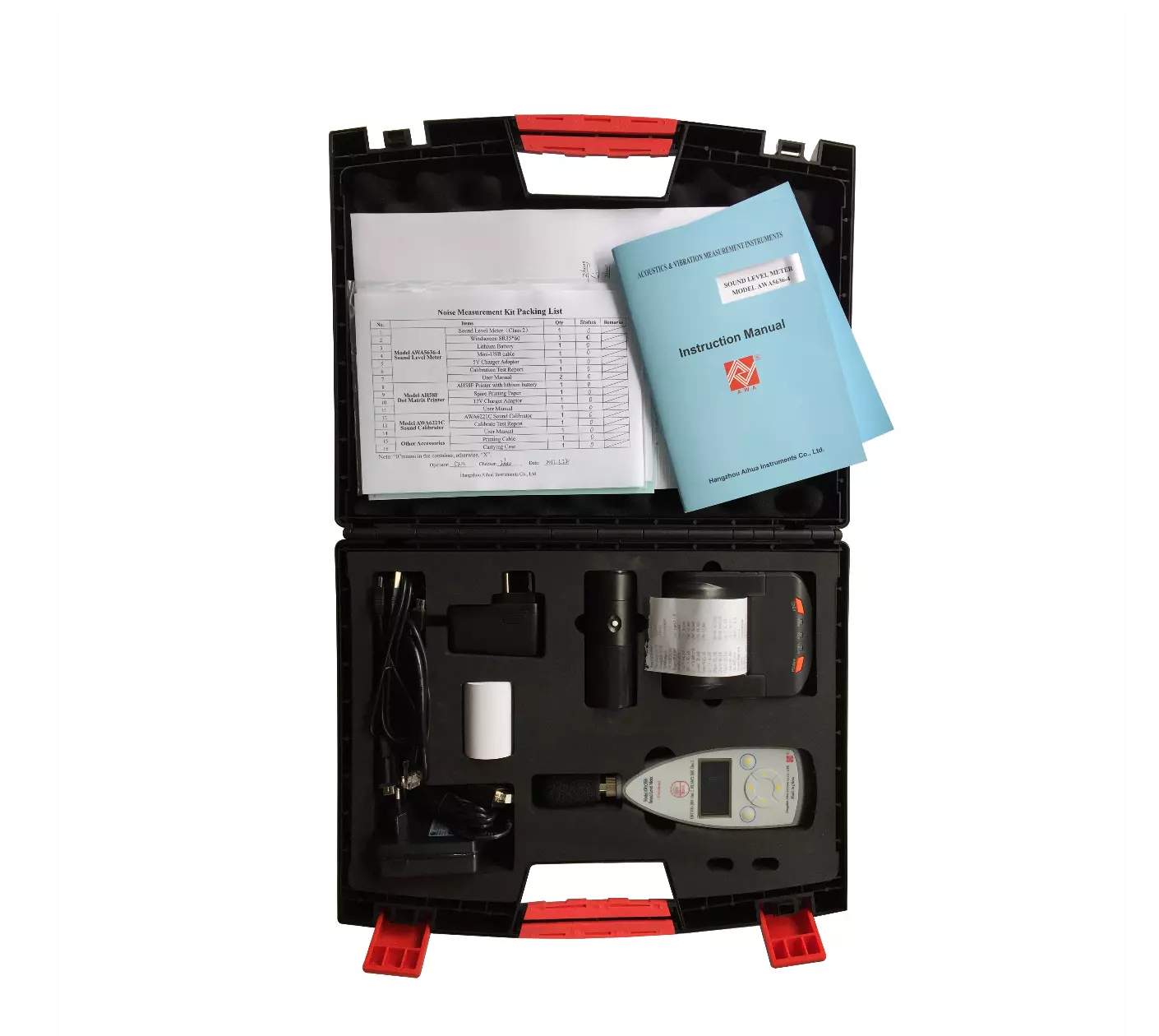
AWA5636 Portable Sound Level Meter Kit

When on-site documentation matters as much as the measurement, the AWA5636 kit delivers a complete solution in one carry case — meter, printer, calibrator, and case included. Wireless printing produces time-stamped noise level reports directly on site, making it ideal for industrial noise surveys and community noise ordinance responses.

AWA6228+ Digital Multifunction Sound Level Meter

AWA5636 Portable Sound Level Meter Kit

The AWA5636 Portable Sound Level Meter Kit is a complete noise measurement solution, supplied with a printer, calibrator, and carrying case. 

Ideal for industrial noise surveys, community noise ordinance measurements, and environmental noise monitoring applications.

     View Details →    

Common Mistakes to Avoid

Skipping calibration — always check against a certified calibrator before and after each session.

Wrong microphone placement — position at ear height, 1.2 to 1.5 metres from the ground, away from reflective surfaces.

Wrong frequency weighting — use A-weighting for occupational and environmental work unless the application specifically requires otherwise.

 Contact Our Team    

marketing@hzaihua.com

Measuring Loudness Accurately Starts with the Right Equipment

The fundamentals of loudness measurement are accessible to anyone willing to understand the tools and methods involved. Use a calibrated, certified instrument, apply the correct parameters, and document everything.

The AWA5688 and AWA5636 kit from Aihua Instruments gives noise measurement professionals everything they need — without compromise on accuracy or compliance.


Copyright ©2026 Hangzhou Aihua Instruments Co., Ltd. All Rights Reserved ICP record number:浙ICP备11012277号-1