Can your workers hear each other clearly without raising their voices? Do employees leave their shifts with ringing ears? These are more than just comfort issues — they are early warning signs that acceptable noise levels in the workplace may already be breached. Noise is one of the most prevalent and underestimated occupational hazards worldwide, yet it remains one of the easiest to measure and control with the right tools. This guide breaks down the legal limits, environment-specific benchmarks, health risks, and — critically — how modern workplace noise measurement instruments give you the data you need to stay compliant and protect your team.
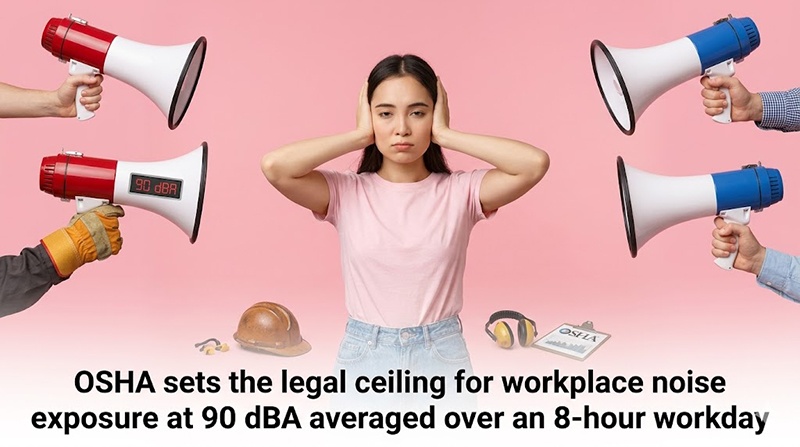
In the United States, the Occupational Safety and Health Administration (OSHA) sets the legal ceiling for workplace noise exposure at 90 dBA averaged over an 8-hour workday (29 CFR 1910.95).
Even before the 90 dB legal limit is reached, OSHA requires employers to act at 85 dBA. At this level, a mandatory hearing conservation program must be implemented, covering noise monitoring, audiometric testing, employee training, and the provision of hearing protection devices (HPDs). Internationally, instruments must meet IEC 61672 Class 2 standards to be legally compliant in most jurisdictions.

There is no universal "safe" number. Acceptable noise levels in the workplace vary significantly depending on the nature of the work:
Workplace Type | Key Concern | |
Open-plan office | 45–55 dB(A) | Focus & communication |
Private office/meeting room | 35–45 dB(A) | Deep concentration work |
Call centers/customer service | 50–65 dB(A) | Speech intelligibility |
Light manufacturing | 70–85 dB(A) | Hearing protection threshold |
Heavy industry/construction | 85–100+ dB(A) | Mandatory HPD & monitoring |
Warehouse/logistics | 75–90 dB(A) | Dosimeter monitoring needed |
For office environments, 45–65 dB(A) is the accepted range. Tasks requiring deep concentration perform best at or below 40 dB(A). For heavy industry and construction, exposure routinely exceeds 85 dB(A) — making continuous monitoring not just best practice, but a legal obligation.
Understanding the risk starts with measurement. You cannot manage what you cannot measure — and guesswork has no place in workplace noise compliance. There are two tools every EHS professional needs: a sound level meter for area surveys and a noise dosimeter for personal shift exposure monitoring.
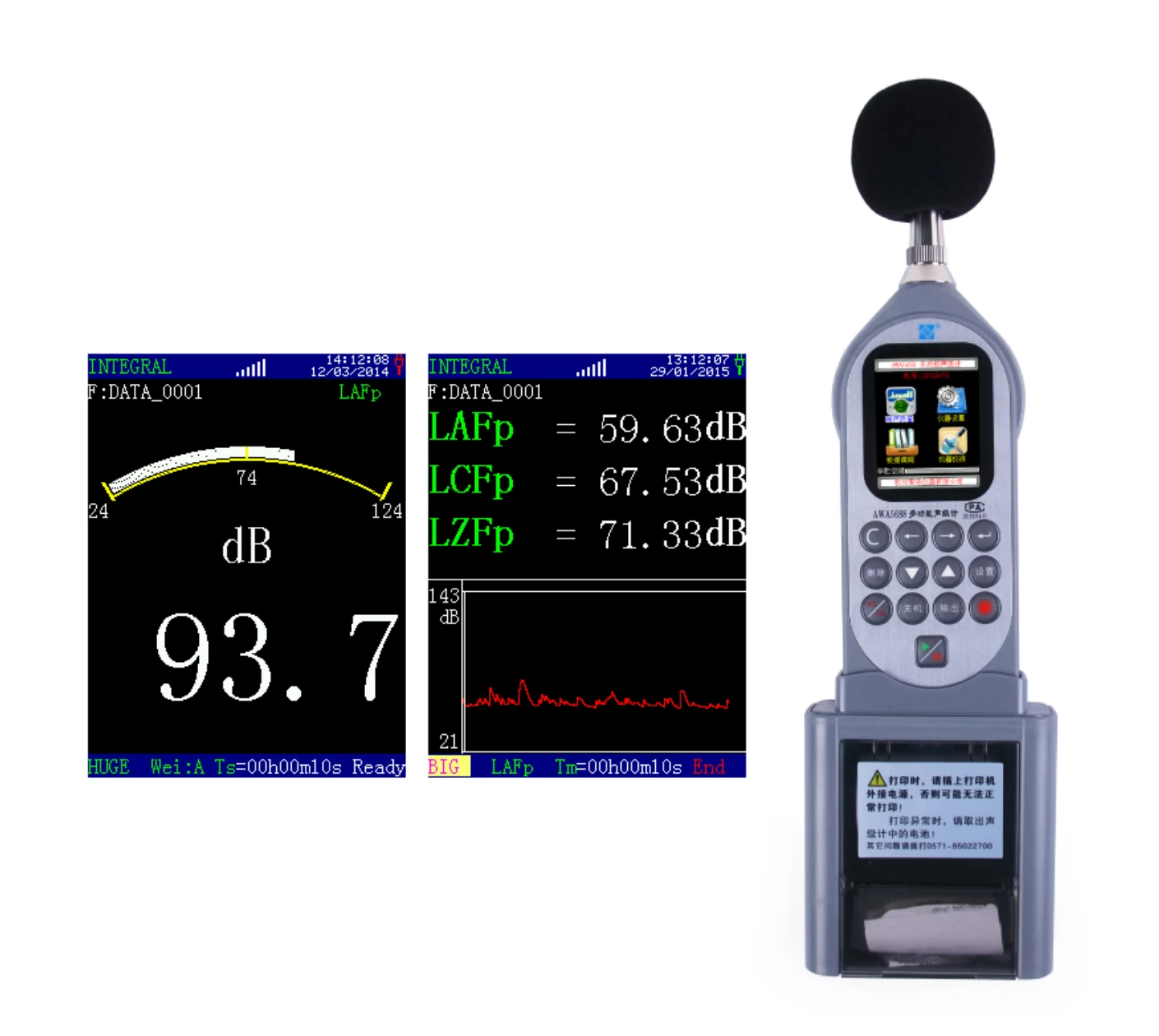
When you need to quickly identify noise hotspots, conduct pre-compliance audits, or verify that engineering controls are working, the AWA5688 Multifunction Sound Level Meter from hzaihua.com gives you a single device that replaces an entire toolkit.

Model AWA5688 Handheld Multifunction Sound Level Meter has advantages of low power dissipation, powerful function, friendly and colorful display screen, and abundant content.
Comply with IEC 61672 Class 2, IEC61260 Class 2, and IEC 61252
Compliance officers often struggle with carrying multiple instruments across large sites. The AWA5688 solves this by integrating a sound level meter (SLM), 1/1 octave band analyzer, 1/3 octave band analyzer, and noise dosimeter function — all in one handheld unit. Its measurement range of up to 133 dB covers everything from quiet offices to the loudest factory floors, while the 240×320 color display makes real-time data immediately readable, even in bright outdoor conditions
Area readings tell you about the environment. But does that reflect what your workers actually experience during their shift? Workers move between zones, take breaks in quieter areas, or spend disproportionate time near specific machines. Only a personal noise dosimeter gives you the true, legally defensible individual exposure figure.
The AWA5920 Noise Dosimeter is purpose-built for this. At just 119 grams with a cable-free, modular design, workers barely notice they're wearing it — eliminating the behavior changes that compromise readings with bulkier devices. The dual-channel capability monitors two microphone positions simultaneously, and IP65 certification means it survives dusty warehouses, wet production lines, and outdoor construction sites without issue.
The AWA5920 kit comes with 5 dosimeter units and 1 sound calibrator — ideal for teams that need to monitor multiple workers in a single shift without repeat sessions. Data downloads instantly via the included PC software package, generating shift reports ready for your hearing conservation records. Compliant with IEC 61672, IEC 61252, ANSI S1.25, and IEC 61260.
Whether you manage a busy open-plan office or a high-output manufacturing floor, acceptable noise levels in the workplace are not a matter of guesswork. The rules are clear: 85 dBA triggers action; 90 dBA is the legal ceiling. But legal compliance is only the floor — protecting your workers' long-term hearing health, productivity, and wellbeing requires ongoing, accurate measurement.
The AWA5688 Sound Level Meter and AWA5920 Noise Dosimeter Kit from hzaihua.com give EHS managers and safety officers the professional-grade tools to meet that responsibility — instruments built to international standards, designed for real-world conditions, and engineered to make compliance reporting effortless.
Don't wait for a regulatory inspection or a workers' compensation claim to expose the problem. Visit hzaihua.com today to explore the AWA5688 and AWA5920 — and give your team the protection their hearing deserves.